

You said four normal words. His whole body changed.
You asked "can we talk?" the way you'd ask anyone. Calm, even kind. And in the space of a breath his jaw set, his shoulders came up, and the man across from you went somewhere you couldn't reach. You stood there thinking, what did I do wrong?
Usually, nothing. There is a translation gap.
When you are married to a man who carries childhood trauma, your words do not always arrive the way you sent them. They pass through his nervous system and his oldest fears before they ever reach him, and they come out meaning something you never said.
Here is what the gap sounds like:
- You say "can we talk?" He hears "I'm in trouble. I did something wrong."
- You say "I need some space." He hears "you're leaving."
- You say "that's not what I meant." He hears "your feelings don't matter."
- You say "why are you so upset?" He hears "you're too much."
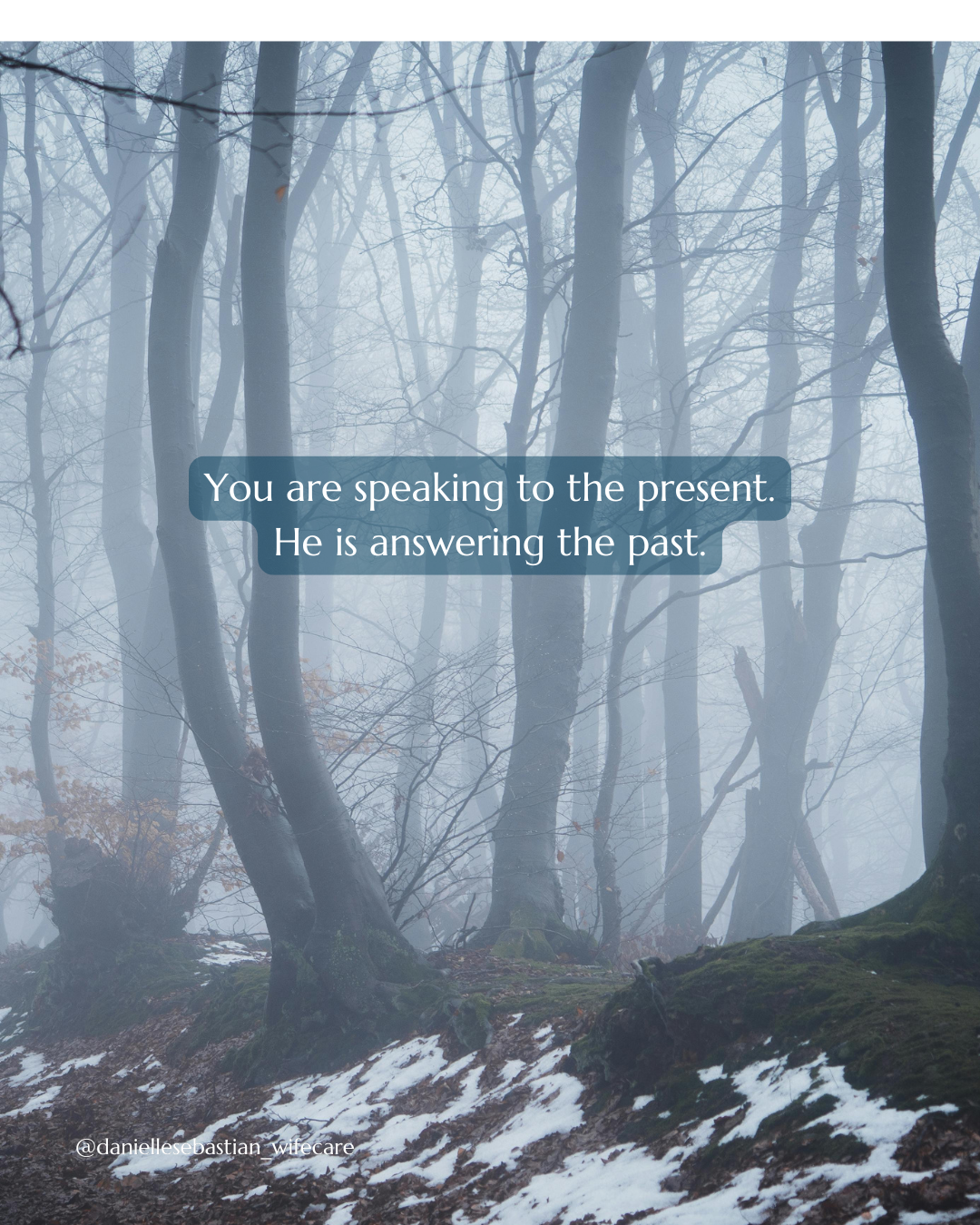
You are speaking to the present. He is answering the past. And when neither of you knows the gap is there, you get stuck in the same loop, you explaining yourself, him bracing against a threat that is not in the room.
The bear that was actually a stump
Let me tell you something that happened to me, because it is the clearest picture I have of what is going on inside him.
I was outside one evening and I was certain I saw a bear. My heart started pounding. My whole body braced. I was ready to run.
I looked closer. It was a stump.
Nothing dangerous at all. But for a few seconds my body did not know that. It reacted like the threat was real, because in that moment, to my brain, it was.
That is what childhood trauma does to the man you love. It convinces his brain "this is a threat," even when it is only you asking about dinner. The reaction is real. The danger is not. And once you can see that, you stop taking the bear personally.
What to do with the gap
You cannot close this gap by walking on eggshells. Shrinking your words to dodge his reactions just teaches you to disappear, and the reactions find you anyway. This is about seeing clearly, not tiptoeing.
Three things that help in the moment:
- Catch the misread instead of matching it. When his face changes over something small, that is your cue that an old fear just got tripped, not a sign you did harm.
- Say the safety out loud. A simple "I'm not upset with you, I just want to figure this out together" often reaches him faster than the point you were trying to make.
- Remember whose alarm is going off. His reaction is his nervous system protecting him from a stump it swears is a bear. It is not a verdict on you.
A woman I worked with told me that once she understood this, the fights that used to swallow whole evenings started to lose their grip. She stopped chasing his misreads and started naming, gently, that she was safe to talk to. Not perfect. But the wall came down more often than it went up.
Where to start
You do not have to keep guessing what set him off. I built a free 2-minute assessment that shows you the exact pattern the two of you keep landing in, so you know where to begin. Comment or DM me QUIZ and I'll send it, or find it here:
And save the date. On Thursday, August 6 at noon Central, I'm teaching a live workshop, "What to Do When He Shuts Down, Snaps, or Pulls Away." It's the in-the-moment plan for exactly these standoffs. Live only, no replay.
One question before you go: what is a normal sentence that turns into a standoff in your house? Sit with it. Naming the gap is the first step to closing it.
With love,
Danielle 💛
Stay connected with news and updates!
Join our mailing list to receive the latest news and updates from our team.
Don't worry, your information will not be shared.
We hate SPAM. We will never sell your information, for any reason.