
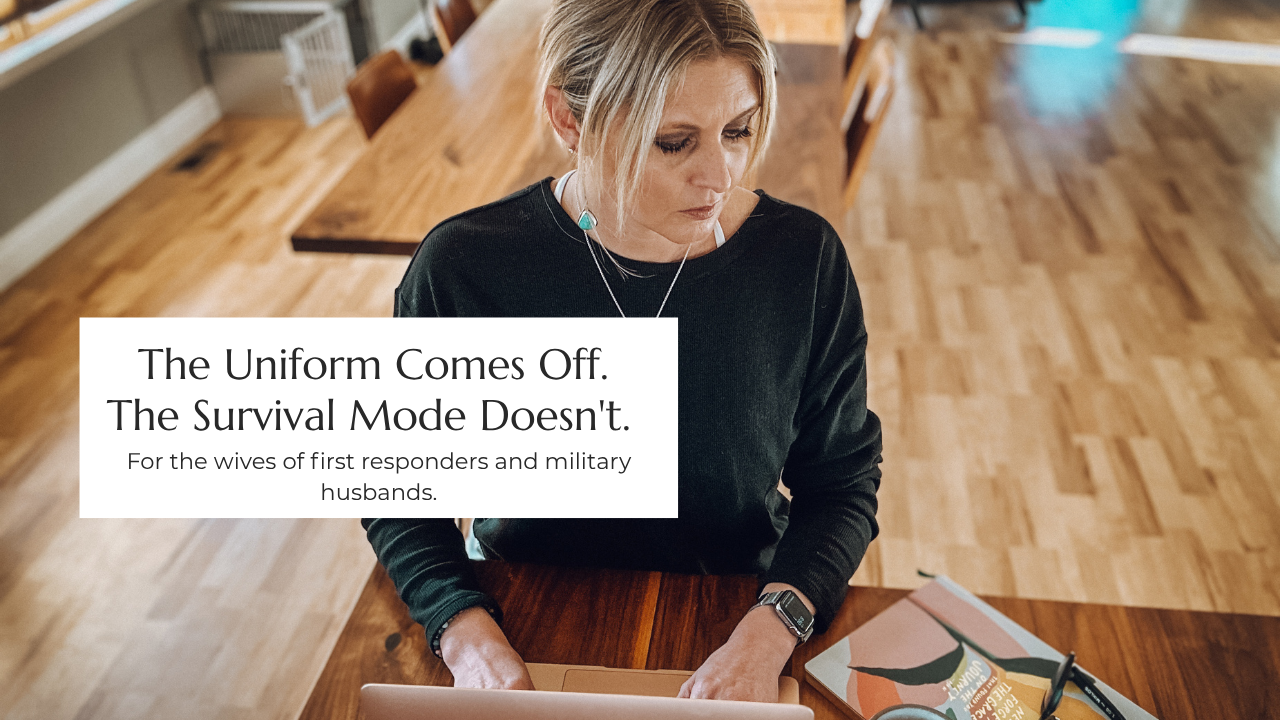
You hear the truck in the driveway. And before he's even through the door, you're already reading him.
What kind of shift was it? Which version of him is walking in tonight? The kids come running, "go check in with Dad," and you catch yourself bracing, doing the math on whether now is a safe moment or whether you should keep everyone out of his way for a while.
If that's your evening, over and over, you are not crazy and you are not alone.

I lived it for years. And I'll tell you what I got wrong, because it's the thing so many of us do. I was a pressure cooker. When he pulled away, I pushed. I pushed for connection, for a conversation, for reassurance, all of it coming from fear. And every time I pushed, I pushed him further away. The very thing I was doing to feel close to him was the thing driving him into the garage.
I only understood why when I sat down with two trauma therapists, Cindie Woods and Gypsy Ray. What they said reframed my whole marriage.
Watch the full conversations on YouTube: Part 1: WATCH HERE Part 2: WATCH HERE
"It's not you. He doesn't trust anyone."
That was Gypsy, and it was a game changer for me. When a man has spent a career, and often a childhood, in survival mode, the part of his brain that connects and trusts goes offline. As Cindie put it, the thinking brain shuts down and the body takes over, fight, flight, freeze, or fawn. He's not rejecting you. He is trying to survive something his nervous system still believes is a threat.
So when he shuts the door, or goes quiet, or disappears for an hour, here is the line I want you to hold onto, straight from Gypsy: space is not always rejection. Sometimes it's regulation.
The transition home
Here is the shift that changed everything in my house, and it's built for exactly this life.
Cindie and Gypsy taught me about the transition home. Before "go check in with Dad," before the questions and the to-do list and the kids climbing on him, he needs to come down. Let him take off the uniform. Get into his own space. Decompress from whatever he carried through that door.
For us, it started as a 30-minute break. And that small, protected window did more for our connection than years of me pushing ever did. Because when he's had the space to close the gap between survival mode and home, he can actually show up. He can come in.
Why this hits first responders and military families so hard
There's a reason so many of the men in these careers carry this. Cindie and Gypsy named it: there's often a strong pull to help people when you didn't get the help you needed as a kid. The coping skills that helped him survive a hard childhood become a superpower on the job. The hypervigilance, the compartmentalizing, the ability to run toward the thing everyone else runs from. It works out there.
Let me give you a picture of what that looks like up close. This 4th of July, while my kids and I watched fireworks at the ballgame, my husband was responding to a house fire. A firework had landed in a juniper bush outside a family's home and smoldered quietly until everyone had gone inside. Then the whole front of the house went up. The family got out. The cat got out. The house was a total loss.
When the crew asked if there was anything sentimental they could try to save, that family didn't ask for photos or heirlooms. They asked them to get the packed cars out of the garage. They were leaving on vacation the next morning, so at least they would have clothes. And after the fire was out, while my husband was doing the investigation, he heard something in the basement. It was the family's teenage son, who had snuck back into a burned, unstable house to find his childhood stuffed animal.
My husband woke me at 2am to tell me all of this, matter of fact, almost flat, and then he went back to sleep.
That flatness isn't coldness. It's the armor. It's how he carries what he carries and still gets up for the next shift.
And it just doesn't work so awesome at home. The same armor that keeps him alive on shift is the armor between the two of you at the dinner table.
Can it actually change?
I asked them straight, because it's the question I know you're carrying. What would you say to a woman wondering if things can actually get better?
Gypsy didn't hesitate: "Yes. If you're willing to work on change for yourself and hold space for your partner, it can get better. Trauma is treatable."
That's not me, the coach, telling you to keep the faith. That's a clinician who does this work every day.
The part I most want you to hear
One thing became clear across both of those conversations. Start talking about trauma in your home, not as something wrong with him, but as something you're both learning to understand. Once trauma has language, it stops feeling so personal.
And this: healing in the relationship was never meant to be a one-person job. You don't have to carry it alone, and you don't have to lose yourself to love him through it.
If you're the wife reading him before he's through the door every night, it helps to know what's actually driving the pattern underneath. I built a free 2-minute assessment for exactly that. See what's really going on in your marriage:
Stay connected with news and updates!
Join our mailing list to receive the latest news and updates from our team.
Don't worry, your information will not be shared.
We hate SPAM. We will never sell your information, for any reason.